
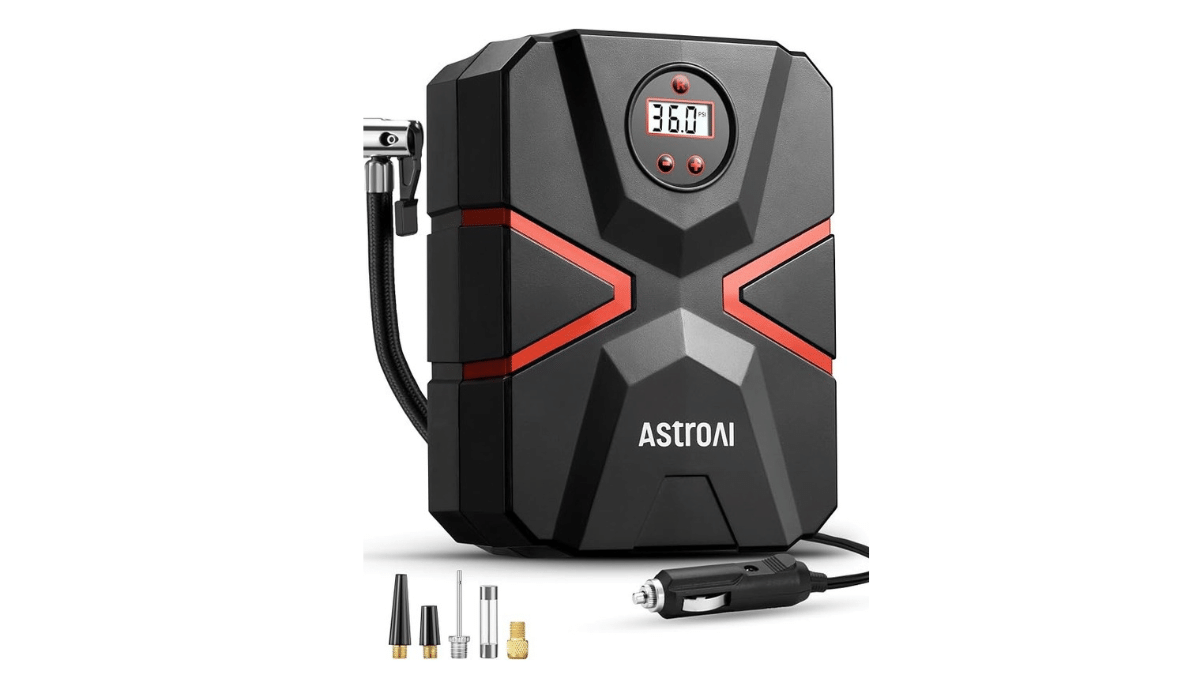
Choosing the right air compressor portable system is one of the smartest investments a UK driver, home mechanic, or site contractor can make. Whether you are dealing with a slow tyre puncture on a rainy motorway hard shoulder, running air impact wrenches in a residential garage, or powering heavy pneumatic breakers on a commercial civil engineering site, having reliable compressed air on demand saves hours of downtime and hundreds of pounds in call-out fees.
Because the market ranges from palm-sized 12V emergency tyre inflators—such as the popular AstroAI Tyre Inflator Air Compressor 12V DC, Digital Car Tyre Pump 150PSI—to massive rotary screw diesel machines, buyers often struggle to match airflow ratings, tank capacities, and power sources to their exact needs. Buying an underpowered unit leads to overheated motors and stalled tools, while overspending on industrial machinery wastes capital and storage space.
In this comprehensive UK buying guide, we break down every category—from compact boot-friendly inflators and complete workshop bundles to heavy-duty towable units and high-CFM industrial machines—so you can select the exact model built for your workload.
1. Portable, Handheld & Mini Air Compressors for Cars and Home
Every British motorist knows the frustration of pulling into a petrol station forecourt only to find the coin-operated air line out of order, damaged, or inaccurate. Keeping a dedicated air compressor portable unit in your car boot eliminates that headache entirely, giving you instant control over tyre pressures before long motorway journeys or during cold winter snaps when ambient temperature drops cause PSI levels to fall.
Modern compact inflators generally fall into two power configurations: 12V DC corded models that plug straight into your vehicle’s cigarette lighter socket, and cordless lithium-ion battery units that operate completely wire-free. While 12V corded units offer unlimited runtime as long as your engine is idling, cordless inflators provide unbeatable convenience when topping up motorcycle tyres, bicycle inner tubes, footballs, or caravan wheels parked away from a power socket.
Top Pick for UK Drivers: AstroAI Tyre Inflator Air Compressor 12V DC, Digital Car Tyre Pump 150PSI
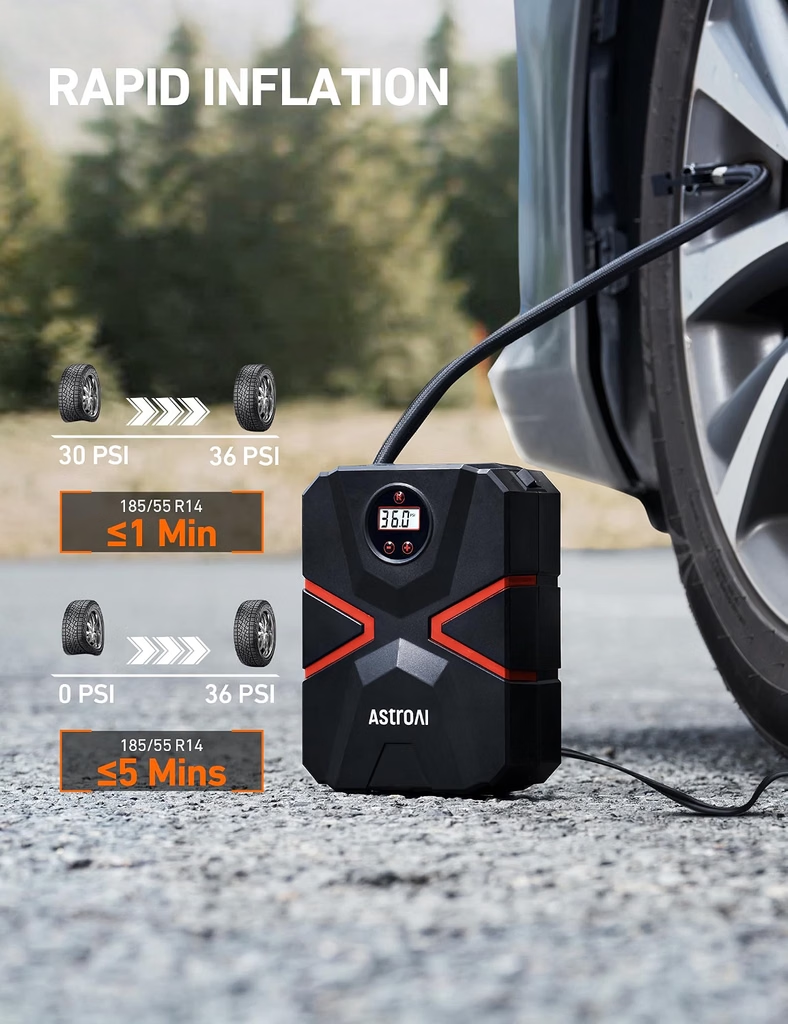
If you want a dependable, boot-ready unit that balances speed, accuracy, and affordability, the AstroAI Tyre Inflator Air Compressor 12V DC, Digital Car Tyre Pump 150PSI is one of the standout choices for everyday UK motorists. Engineered with ToughUltra technology and a durable metal cylinder, it inflates a standard 195/65 R15 car tyre from 0 to 36 PSI in under five minutes.
- Programmable Auto-Shutoff: Simply pre-set your vehicle’s target PSI on the backlit digital LCD screen, and the pump automatically cuts off once reached—preventing dangerous over-inflation in dark or rainy conditions.
- Built-In Emergency LED: Features an integrated ultra-bright LED flashlight for safe roadside tyre checks on unlit B-roads or motorway hard shoulders.
- Long Reach & Multi-Nozzle Kit: Comes with a generous 3-metre (9.8 ft) 12V power cord that easily reaches both front and rear tyres on hatchbacks, saloons, and SUVs, plus adaptors for bicycles, air mattresses, and sports balls.
When storage space inside a glovebox, door pocket, or under-boot organiser is even tighter, choosing a tiny air compressor or a pistol-grip handheld air compressor delivers maximum portability without sacrificing pressure output. Despite their compact footprint, quality micro-compressors generate up to 150 PSI—more than enough for passenger hatchbacks, heavy SUVs, and light commercial vans.
For drivers and DIY enthusiasts who also detail their vehicles, clean dusty computer keyboards, or blow out clogged workshop filters, stepping up to a mini air compressor with air gun attachment adds dual-purpose utility. Instead of wasting money on disposable cans of compressed gas, a compact inflator paired with a tapered blow nozzle blasts trapped dust out of dashboard vents, seat tracks, and engine bays in seconds. To build a complete roadside readiness setup, explore our guide on essential car emergency boot kit items so your inflator is paired with tyre sealants, warning triangles, and heavy-duty jump leads.
2. Understanding PSI, CFM & Duty Cycles Before You Buy
Before comparing specific machines or browsing listings, understanding three core engineering metrics will protect you from purchasing the wrong equipment for your tools:
- PSI (Pounds per Square Inch): This measures air pressure—how hard the air pushes against a surface. Most car tyres require between 30 and 38 PSI, commercial van tyres need 50 to 70 PSI, and standard workshop pneumatic tools operate at 90 PSI. Almost every modern unit easily reaches 100+ PSI, so pressure alone rarely limits performance.
- CFM (Cubic Feet per Minute): This measures air volume—how much air the pump actually delivers over time. While PSI inflates a tyre, CFM powers continuous air tools. A small tyre inflator produces roughly 1 to 1.5 CFM, whereas a sandblaster, orbital sander, or heavy road breaker demands anywhere from 10 CFM to over 400 CFM. Always check the continuous CFM rating of your highest-demand tool and add a 30% safety buffer.
- Duty Cycle: Expressed as a percentage (for example, 50% duty cycle over 10 minutes), this tells you how long a pump can run before needing to cool down. Budget 12V inflators typically run for 10 to 15 minutes before requiring a short rest, whereas industrial rotary screw machines are engineered for 100% continuous operation across eight-hour shifts.
3. Workshop Compressors, Kits & Brand Spotlights
Once your needs expand beyond inflating tyres to running air impact wrenches, ratchets, HVLP spray guns, brad nailers, or tyre changers, a tankless portable inflator is no longer sufficient. You need a stationary or wheeled workshop compressor fitted with a pressurised steel receiver tank.
Receiver tanks—commonly sized at 24 litres, 50 litres, or 100 litres for UK home garages and small MOT bays—act as compressed air reservoirs. When you pull the trigger on an impact gun, the tool draws stored air from the tank rather than relying solely on the pump motor. Once tank pressure drops below a preset cut-in threshold (usually around 85 PSI), the electric motor automatically kicks in to replenish the tank up to 115–145 PSI and shuts off again.
Oil-Free vs. Oil-Lubricated Pumps
When choosing a garage unit, you will encounter two primary pump designs:
- Oil-Free Compressors: Coated with permanent Teflon-style lubricants inside the cylinder walls, these models require zero oil changes, weigh less, and produce cleaner air free from oil mist—making them ideal for indoor spraying, airbrushing, and low-maintenance DIY use.
- Oil-Lubricated Compressors: Equipped with an oil sump that bathes the crankshaft and pistons, these pumps run cooler, last significantly longer under heavy daily use, and operate at a deeper, less piercing pitch.
Why Bundled Kits Save Money
If you are outfitting a garage from scratch, buying bare machinery and sourcing hoses, quick-release PCL couplings, and gauges individually quickly inflates your budget. Investing in complete air compressor kits or an all-in-one compressor pack provides immediate plug-and-play functionality. A well-equipped bundle typically includes a 5-to-10-metre coiled recoil airline, a gravity-feed paint spray gun, a paraffin degreasing gun, a trigger blow gun, and a calibrated tyre inflator chuck—often saving 25% to 35% compared to buying each accessory separately.
Spotlight: Pollor Air Compressor
Among UK home mechanics, mobile valeters, and woodworking hobbyists, a pollor air compressor has become a standout choice for residential setups. Traditional piston compressors often generate upwards of 90 to 95 decibels—loud enough to trigger neighbour complaints on suburban driveways. Pollor models utilise low-RPM, twin-cylinder oil-free motors housed inside vibration-dampened frames, operating around 58 to 65 decibels (roughly the volume of normal conversation) while still delivering rapid tank recovery times and solid CFM output for everyday garage tasks.
4. Heavy-Duty Road, Diesel & Towable Compressors
Moving away from domestic 240V three-pin sockets into civil engineering, highway maintenance, agricultural contracting, and mobile commercial tyre fitting requires industrial-grade equipment. On remote British motorways, housing developments, and quarries where mains electricity simply does not exist, contractors search for a rugged road compressor for sale built specifically to endure torrential rain, freezing winters, and relentless daily abuse.
In these demanding environments, electric motors are impractical. Selecting a diesel compressor for sale delivers superior low-end torque, extended fuel tank autonomy for full-shift operation, and effortless refuelling alongside excavators and dumpers on site. Unlike reciprocating piston pumps used in garages, heavy-duty site units rely on rotary screw airends—two precision-machined helical rotors that trap and compress air smoothly with minimal vibration and 100% continuous duty capability.
When browsing UK plant dealers for road compressors for sale, leading brands like Atlas Copco, Kaeser, Doosan, and CompAir dominate the market thanks to nationwide spare parts availability and weatherproof canopies. Furthermore, for utilities crews and mobile contractors who move between multiple locations every day, exploring towable compressors for sale mounted on single-axle highway trailers—complete with overrun brakes, road-legal LED lighting boards, mudguards, and adjustable towing eyes—allows any standard van or 4×4 pickup to transport massive pneumatic power straight to the trench.
5. High-Capacity Industrial Units: 250 CFM vs 400 CFM
When scaling up to commercial rotary screw machinery, choosing the right airflow tier prevents costly bottlenecks on site. Two of the most widely searched capacity brackets in the UK industrial sector are 250 CFM and 400 CFM machines:
When to Choose a 250 CFM Compressor
Browsing listings for a 250 cfm compressor for sale hits the sweet spot for general roadworks, utilities maintenance, and medium-scale surface preparation. A 250 CFM unit (typically operating around 7 to 10 bar / 100 to 145 PSI) comfortably powers:
- Two heavy-duty 30kg pneumatic road breakers running simultaneously without pressure drop.
- Medium-nozzle grit and sandblasting pots for stripping rust from steelwork or brickwork.
- Pneumatic scabblers, mole-boring tools, and commercial air-operated diaphragm pumps.
When to Upgrade to a 400 CFM Compressor
For high-demand infrastructure and deep-ground engineering, contractors step up to a 400 cfm compressor for sale (frequently listed across UK machinery catalogues as a 400cfm compressor for sale). Delivering nearly double the air volume—often paired with higher pressure options up to 12 or 14 bar—a 400 CFM machine is essential for:
- Fibre-optic broadband duct blowing across long rural stretches.
- Down-the-hole (DTH) water-well drilling and quarry rock boring.
- High-production industrial shot blasting and pipeline pressure testing.
Before operating any high-capacity receiver or site unit in a commercial workplace, UK employers and contractors must ensure full compliance with statutory inspection schedules under the Pressure Systems Safety Regulations 2000 (PSSR), as detailed by the Health and Safety Executive (HSE). For a full breakdown of how to inspect commercial air receivers and check statutory Written Schemes of Examination (WSE), see our UK equipment inspection and safety guide.
6. Quick Comparison Table: Matching the Compressor to Your Job
| Category | Best Use Case | Power Source | Typical Output | Ideal Buyer |
|---|---|---|---|---|
| Portable / 12V Inflator (e.g., AstroAI 150PSI) | Car tyres, bikes, air beds, roadside emergencies | 12V DC / Li-Ion Battery | 1 – 2 CFM (up to 150 PSI) | Everyday UK motorists & cyclists |
| Workshop & Kits | Impact wrenches, spray painting, nailers | 240V Mains Electric | 8 – 14 CFM (24L–100L Tank) | Home mechanics & small garages |
| 250 CFM Towable | Twin road breakers, light grit blasting | Diesel Engine | 250 CFM (7–10 Bar) | Civil, utility & tarmac contractors |
| 400 CFM Industrial | Fibre-optic blowing, quarry drilling | Heavy Diesel Engine | 400 CFM (7–14 Bar) | Major infrastructure & drilling firms |
7. Maintenance & Safety Best Practices for Long-Term Reliability
Even the highest-specification air compressor portable unit or industrial rotary screw plant will suffer premature failure without basic routine care. Implementing four simple habits dramatically extends equipment lifespan:
- Drain Tank Condensation After Every Use: Compressing ambient UK air squeezes moisture out of the atmosphere directly into your receiver tank. Always crack the bottom drain valve after shutting down to expel water and prevent internal rust.
- Clean or Replace Intake Air Filters: Dusty workshops and construction sites quickly clog foam and paper intake elements, starving the pump of air, spiking operating temperatures, and accelerating piston ring or rotor wear.
- Use Proper Extension Leads (Or Longer Air Hoses): Never run a 240V workshop unit on a long, coiled domestic extension cable—voltage drop causes electric motors to overheat and trip thermal overload switches. Always plug directly into a wall socket and use a longer rubber air hose to reach your work area instead.
- Never Bypass Safety Relief Valves: Every pressurised receiver features a brass spring-loaded safety relief valve designed to vent excess pressure if the main pressure switch fails. Test the manual pull-ring periodically and never tamper with factory pressure limits.
8. Frequently Asked Questions
What size air compressor portable unit do I need for car tyres?
For standard passenger hatchbacks, SUVs, and light vans, a compact air compressor portable model rated at 120 to 150 PSI—such as the AstroAI Tyre Inflator Air Compressor 12V DC, Digital Car Tyre Pump 150PSI—will inflate a flat tyre safely in 3 to 5 minutes with accurate digital auto-shutoff.
What is the difference between a 250 CFM and 400 CFM compressor?
Airflow capacity is the primary difference. A 250 CFM machine supplies sufficient compressed air to run two heavy pneumatic road breakers or light sandblasting equipment simultaneously, whereas a 400 CFM unit delivers nearly double the volume—making it necessary for continuous high-demand applications like fibre-optic cable blowing, deep rock drilling, and large-scale industrial blasting.
Can I run an impact wrench off a small 12V car tyre inflator?
No. While a 12V tyre inflator generates high pressure (PSI), it lacks a pressurised storage tank and produces very low air volume (CFM). Pneumatic impact wrenches require sudden bursts of high-volume air from at least a 24-litre or 50-litre workshop receiver tank to break seized wheel nuts loose effectively.
How often should I drain the air tank on a workshop compressor?
You should open the drain valve at the bottom of the receiver tank after every single working session to release trapped moisture and prevent internal steel corrosion.